
To boldly go… over there.
Just a short post today, because I’m feeling pretty good about a recent small side project.
So, while I don’t get too much time to play video games these days, when I do I tend to play one game for a while until I’m bored of it, and then switch to something else.
For the last year, that game has been Space Engineers. For those unaware, Space Engineers is a sandbox survival game. You start as a lone engineer in a pod, or a rover (or a very basic space ship), armed with just a set of tools and a dream. You’re dropped on a planet and left to your own devices. You need to explore, find resources, mine and refine them, and use those resources to build… anything. Literally anything. A dune buggy? Easy. A space ship. Got you covered. Want to hollow out an entire mountain and build a Bond villain style hideout? You can do that too.
There’s lots of physics, and mechanics and all manner of interesting stuff to build with, as well as trade stations, enemies to fight (or hide from), and other secrets to discover. Basically, you can do whatever you want, and that makes it pretty fun to play.
One aspect of the game that was somewhat lacking was the GPS / Waypointing system. This is pretty essential as, when exploring, setting GPS points to mark the location of ore deposits, ice lakes etc., is critical to survival. Running out of resources is not fun.
It’s a little rudimentary and, after a while, you end up with a huge list of them, with no real way of organising them or even any idea of how far away each one might be. Until now!
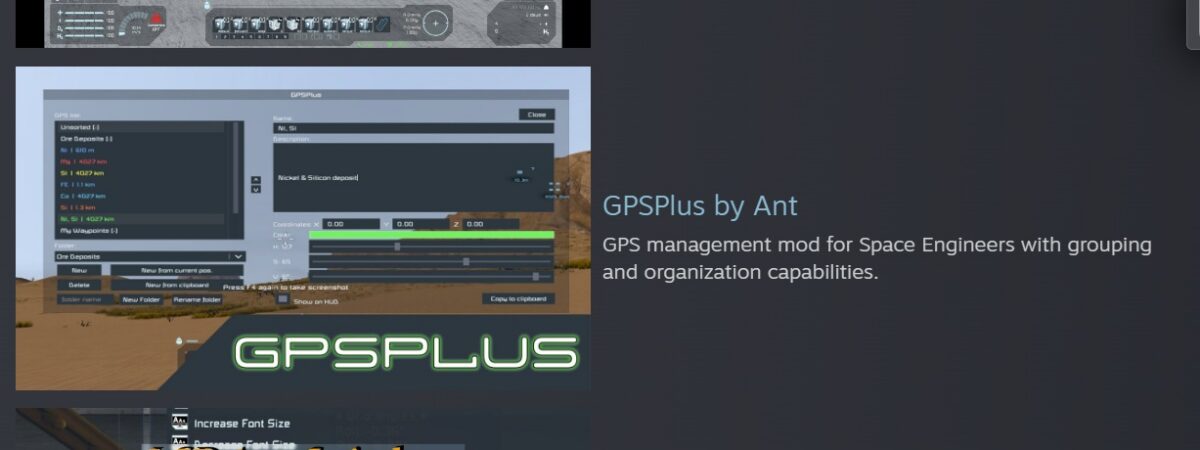
This wasn’t intentional. But, being an accidental location nerd, I decided to build an improved GPS system to let me organise and better manage waypoints in-game. Due to limitations in the modding API, this became a sort of wrapper layer for the built in system, but expanded with folders, better organisation tools, distance indicators and more.
Now, this is all probably of no interest to you if you don’t play the game, but I found it pretty useful when playing, and so I published it to the Steam Workshop. It picked up a few subscribers fairly quickly, and then sort of sat there for a while, not doing much. Fine by me. I wanted it, so I built it.
But then, this week, it was featured in the Community Spotlight section of the game developer’s monthly newsletter, which is actually pretty cool, I think. In the last 24 hours, there’s been a surge of subscribers, lots of positive feedback and a few feature requests / improvement suggestions. It’s suddenly become an essential mod for quite a few people, it seems, and I’m weirdly proud of that. 🙂